





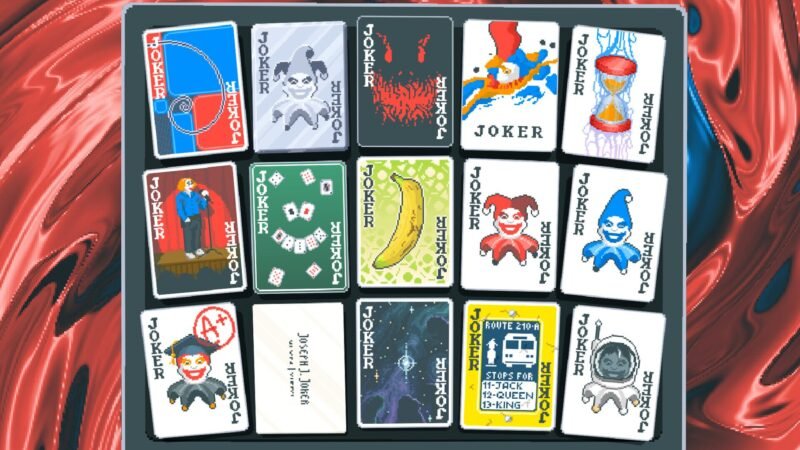
Balatro looks like a poker game, but its most interesting decisions often happen before the cards are played.
The first few hours of Balatro teach a familiar lesson: a Flush is better than a Pair, a Straight is harder to assemble than Two Pair, and rare Jokers must be powerful because they are rare. Then a run breaks all of those assumptions.
Suddenly, High Card is scoring more than a Full House. A common Joker is carrying the run while a rare one does almost nothing. Moving one card from the left side of the Joker row to the right adds thousands, millions, or eventually far more points without changing the hand at all.
That is the moment Balatro stops being a poker game with bonuses and reveals itself as an engine-building game about sequence.
The Equation Is Simple; the Sequence Is Not
Every Balatro hand ends with the same basic calculation:
- Score = Chips × Mult
Chips are the blue number. Mult is the red number. If a hand finishes with 100 Chips and 20 Mult, it scores 2,000 points.
The difficulty is that neither value stays still. The hand type and its level establish a base. Played cards can add Chips, Mult, or other effects. Cards held in hand may trigger. Jokers then modify the running total, usually from left to right. Some effects add a fixed amount of Mult, some multiply the Mult already accumulated, and others copy or repeat an effect.
The final multiplication is easy. Understanding how the game reached those two final numbers is the real puzzle.
A Two-Joker Example
Imagine a hand reaches the Joker phase with 100 Chips and 10 Mult. You have two simplified effects:
- Joker A adds +10 Mult.
- Joker B applies X2 Mult.
If Joker A triggers first, the calculation is:
- Mult starts at 10.
- Joker A adds 10, raising Mult to 20.
- Joker B doubles 20 to 40.
- The hand scores 100 × 40 = 4,000.
Reverse the Jokers and the result changes:
- Mult starts at 10.
- Joker B doubles 10 to 20.
- Joker A adds 10, raising Mult to 30.
- The hand scores 100 × 30 = 3,000.
The hand, cards, and Joker effects are identical. Only their order changed, yet the first arrangement scores one-third more.
This is the most useful beginner rule for Joker positioning: add first, multiply later. It is not a universal solution, because Balatro is full of conditional, copied, and retriggered effects, but it is an excellent starting point.
Why the “Best Poker Hand” Can Be the Wrong Play
Traditional poker trains us to value difficult hands. Balatro initially reinforces that instinct by giving rarer hands stronger base Chips and Mult. But a mature build often earns most of its score from effects outside the hand’s printed base value.
A High Card build can succeed because it is consistent. It asks for only one playable card, leaving room for Steel Cards or other held-in-hand effects. A Pair build can trigger almost every round without spending several discards. A Straight or Flush may have a stronger base, but missing it entirely scores nothing.
The important question is not “Which poker hand is strongest?” It is “Which hand activates the engine I have built?”
If the Jokers reward repeated small hands, scaling, specific ranks, or cards held in hand, forcing a Full House can be weaker than playing the reliable option. Balatro’s best strategies emerge when the player stops chasing abstract hand value and starts reading the entire scoring path.
Copy Effects Are Powerful Only When the Target Is Powerful
Blueprint and Brainstorm are exciting because they can copy another Joker. But a copy effect has no independent identity; it inherits the quality and timing of its target.
That creates two decisions instead of one:
- Which effect should be copied?
- Where must the copy Joker sit for that effect to resolve correctly?
Copying a large XMult effect may produce the highest immediate score. Copying a retrigger can be stronger when enhanced cards or held-in-hand effects are doing most of the work. In another run, copying an economy Joker before a round may be more valuable than copying score at all.
This is why a powerful Joker can feel useless in the wrong build. Rarity does not fill a missing role automatically. A run still needs enough Chips, enough additive Mult, a way to scale, and enough economy or consistency to find the next useful piece.
Retriggers Make the Scoring Path Harder to Read
Retriggers are where mental arithmetic begins to break down. An effect that activates one additional time does not always mean “double the score.” It depends on what is being repeated and when that repeated effect occurs.
Repeating +Chips is different from repeating +Mult. Repeating XMult can be dramatically stronger because each multiplication acts on a value already increased by the previous trigger. Repeating a card can also repeat its enhancement, edition, seal, or another ability that reacts to that card.
The safest approach is to stop estimating the final number in one leap. Trace the run as a sequence:
- What are the base Chips and Mult for the chosen hand?
- Which played cards score, and what does each one add?
- Which held-in-hand effects activate?
- Which Jokers add Chips or Mult?
- Which effects multiply the accumulated Mult?
- What is copied or retriggered?
For a close Boss Blind, this breakdown is more reliable than trusting the animation or assuming the rarest card must be doing the most work. When the interaction is too complicated to calculate comfortably, a scoring tool such as BalatroCalc can model the hand and compare Joker arrangements before the play.
A Practical Joker-Order Checklist
Before committing a hand, use this short check:
- 1. Identify What the Run Is Missing
Does the build need more Chips, additive Mult, XMult, economy, scaling, or consistency? Buying another interesting Joker is not useful if it does not solve the current problem.
- 2. Put Additive Effects Before Multiplicative Effects
If two Jokers affect the same scoring phase and one adds Mult while the other multiplies it, test the additive Joker on the left and XMult on the right first.
- 3. Check the Copy Target
Blueprint and similar effects should copy the strongest relevant effect for the current moment. That target may change between the shop, the start of a blind, and the scoring phase.
- 4. Account for Conditions
A Joker with a huge theoretical ceiling contributes nothing when its condition is not met. Check the played hand, suits, ranks, remaining discards, money, and Boss Blind restriction.
- 5. Compare Survival With Ceiling
The arrangement that creates the largest possible score is not always the arrangement that keeps the run alive. A consistent setup that clears the next blind is more valuable than a spectacular combo that needs a perfect draw.
Balatro Turns Arithmetic Into Drama
Balatro’s presentation is deliberately restrained: a table, a deck, a shop, and a row of strange Jokers. That simplicity gives every scoring trigger room to perform. Numbers tick upward, cards shake, multipliers fire, and a modest hand suddenly becomes an absurd score.
The spectacle works because the result is not random noise. It is the visible outcome of decisions made earlier: what to buy, what to sell, which hand to support, and where each Joker sits.
Learning Joker order does not remove Balatro’s luck. The shop can still refuse to cooperate, and a Boss Blind can still attack the exact weakness of a build. But understanding the sequence changes a frustrating loss into a readable one. You can see whether the run lacked Chips, whether XMult triggered too early, whether a copy effect targeted the wrong card, or whether the hand simply could not survive the blind.
Once that happens, moving a Joker one position to the right can feel as satisfying as drawing a Royal Flush.
This article was contributed by Bryce Lee, creator of BalatroCalc, a fan-made scoring and Joker-order tool for the hit indie game Balatro. Check out BalatroCalc here.