




A review key was provided by Bandai Namco Asia.
As a long-time Digimon fan, I was elated when news first came out for Digimon Story Time Stranger. I had played some of the old titles, like Digimon Dawn and Dusk, World 3, and Battle Spirit, not to mention Cyber Sleuth, which remains as one of the best Digimon games I’ve played so far (who doesn’t love Nokia and Garurugreymon?).
That is, until Time Stranger came around. It is easily a massive upgrade on many fronts from its predecessor. When I first booted up the game, I was hit by a wave of nostalgia, like I was diving back into the Digital World after a long time. The opening sequence of the game was the cutest thing I had ever seen, with multiple chibi Digimon making their appearance. I had a feeling then that this was going to be something special.
Before I delve into the details, I will note that I went into this game completely blind despite having it already been out for months prior on PC and PS, as I didn’t want to be spoiled. I also won’t talk about the plot, as I think that’s something better discovered while playing! But I will mention how I felt like I was being the wholesome, unserious mom to both Inori and Aegiomon.
Let’s Go!
As a successor to Cyber Sleuth, many of that game’s mechanics have carried over to this title. With it being a Digimon game, one can also expect a whole roster of critters to be discovered, each with diverse digivolution paths to follow. It’s not a rare thing in Digimon to have your dog turn into a cat, then into a woman, and into a dragon. That’s what we love about Digimon, after all – the anticipation of watching your dinosaur launch into the evolution matrix, and wondering what will come out on the other side.
Gameplay revolves around a turn-based system, much like the Shin Megami Tensei series if you’re familiar with that. Our party consists of three Digimon, with three more in backup who can be swapped in any time, and won’t take up a move. Aegiomon is usually there as your guest Digimon, and there will be others who will swap in now and then.
Combat turn is based on each member’s speed stat, with faster ‘mons going first. With the turn order conveniently laid out on the right side of the screen, you can use that to your advantage to see which opponents need to be taken out first, or try and set up buffs and debuffs. By taking out a fast opponent who was supposed to hit you on the next turn, you’ll manage to avoid taking damage altogether.
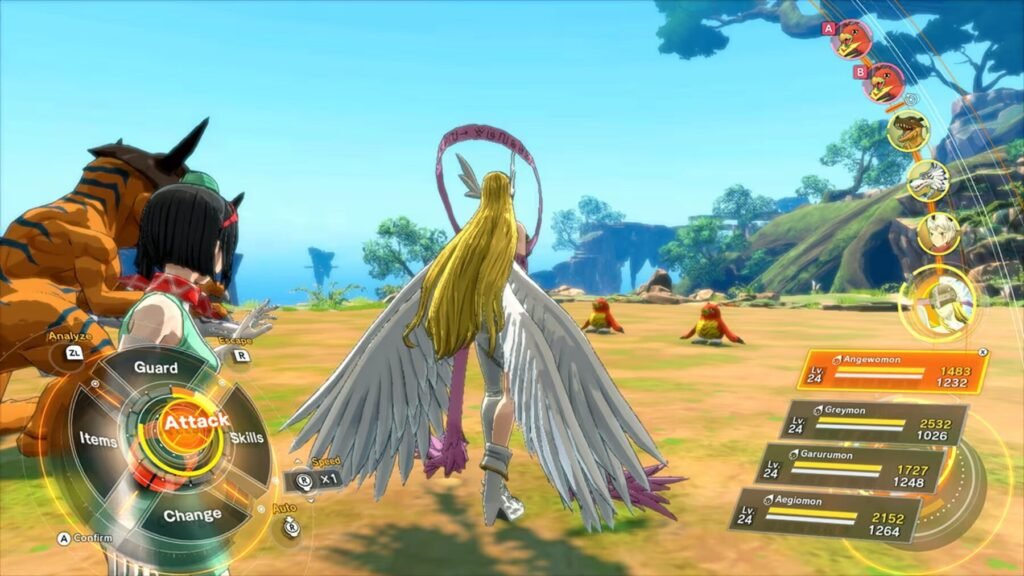
In boss fights, a new charging mechanic is introduced, where the boss uses one or more turns to charge up a powerful attack. When this is happening, there will be a white Break Bar underneath their HP bar. During this time, if you wail on the boss with all you’ve got and manage to deplete the Break Bar, the boss will be stunned and debuffed, giving you a chance to counterattack. And if you fail, there’s the Defend button to try and mitigate as much damage as possible to avoid being KO’d.
While hitting enemies is nice and all, you also need to take note of their attributes, which come in a rock-paper-scissors strength and weakness type. Vaccine is strong against Viruses, Viruses eat away at Data types, while Data overpowers Vaccines. There are also Free, Variable, Unknown and No Data types, which have no resistances and weaknesses toward other attributes. Taking a Data type into a Virus enemy fight is generally a very bad idea, as not only do they hit like a wet noodle, but they also take boatloads of damage in return.
Aside from the Attribute cycle, there are also 11 elements, namely, fire, ice, plant, water, electricity, steel, wind, earth, light, dark and null. Each Digimon is attuned to one of these elements, but they can be equipped with Skill Discs of other elements. This gives rise to many strategies. For example, I can equip an electric disc onto my Greymon, who starts off with fire skills, so that he can counter water types, which he is weak to.
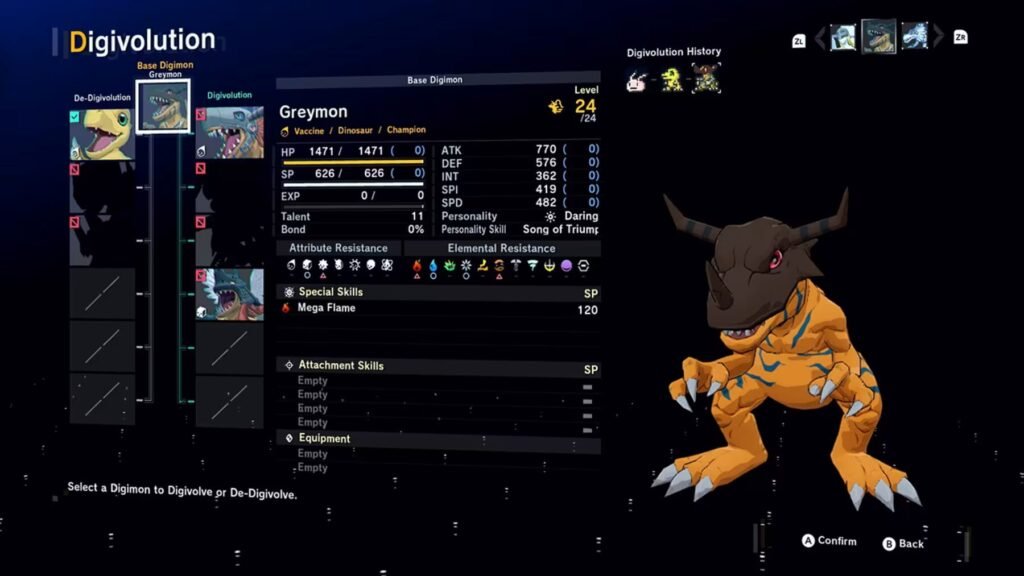
Damage calculation works by tying these two mechanics together. You can reach up to 4x damage with the right combination of attribute and element, as well as the ‘mon’s personal skill, when played right. In contrast, you can deal as little as 0.5x to no damage at all if you chose the wrong type matchup.
I personally wanted a challenge when I booted up the game, so I picked Hard. I’ve had my ass whooped multiple times by the mini bosses alone, but so far, I’ve managed to scrape through with my blind-run team. I haven’t done too much grinding yet, so my ‘mons were always barely at the minimum required level, and the fights had me at my seat’s edge.
And speaking of grinding, this game took away a lot of the tediousness from its predecessor. It has introduced Preemptive Attack, where you can send out your team to strike an enemy roaming in the field. Doing so always ensures you start first, while getting ambushed allows the enemy to get the first hits in, denting your team’s HP. On a successful Preemptive attack, the enemy Digimon can actually be outright KO’d, skipping the fight entirely. But usually, they just get a good chunk of their HP sheared off, giving you an advantage from the start.

There is also now a battle Speed-Up function, allowing you to skip attack animations and go up to 5x faster. Of course, if you’d rather watch your ‘mons call out their cool signature moves to blast away at the enemy, you can leave this setting at 1x or 2x. I tend to slow down at boss fights so I can experience the full cinematic and dramatic effect. For training and grinding EXP and material drops, x5 is the way to go.
Oh, and did I mention that there’s also now a very nifty Autobattle function as well? Toggling this will enable your ‘mons to fight the enemy on their own, using the best moves for the scenario. You can essentially semi-AFK grind if you wanted with these functions enabled, and it was quite a game-changer for me. I can now read my book while playing my game!
One last new feature to note is Cross Arts, where the player Agent can use a set skill to assist your Digimon in battle. There’s an array of Cross Arts which can be learned in the Agent’s Skill Tree, but I found myself defaulting to the direct damage ones for now – the others didn’t feel as impactful. Still, it’s very cool that we can now directly partake in the battle too, and if anything, it’s awesome to watch your Agent zip out their handy-dandy Digivice and blast the enemy with a giant flashbang.
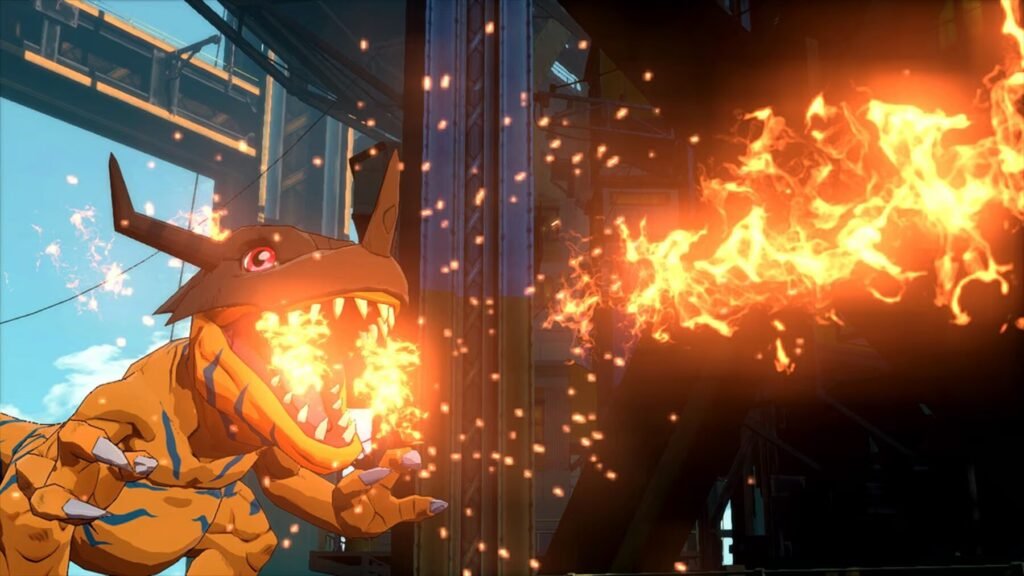
Outside of battles, there’s a whole slew of other things you can do. Most notably are the Side Missions, Outer Dungeons, the DigiFarm and general exploration. I do the Side Missions as they come, as they usually don’t require too much effort, and have pretty good rewards. The Outer Dungeons are fun little challenges and sometimes, very good grinding spots for levels and money. The DigiFarm can be quite complicated to get into, but at the very base explanation, they’re good for increasing stats to hit digivolution thresholds, where normal levelling would not suffice. They also shift your Digimon’s personality, which also plays into their ability and stat growth, as well as devolution and evolution requirements.
Doing missions earn you Agent points, which you use to level Agent skills. They are quality of life upgrades which help your Digimon grow faster, or to decrease evolution requirements. They also unlock new Cross Arts, as well as boost your Digimon’s stats based on their personality. All these systems are admittedly a bit difficult to understand at first, but once you get it down, you’ll be making a team of strong ‘mons in no time, provided you have the moolah to speed things up.
Some Other Notes
Although I had the Switch 1 version, by playing on the Switch 2, I recieved an automatic update which allowed me to choose between two modes upon game startup – Performance Mode, or Quality Mode. Performance mode ensures a buttery-smooth constant 60fps, while Quality gives you better graphics capped at 30fps. I personally went with Performance off the bat, as FPS is much more important to me.
Another interesting thing to take note of is that you can buy the Switch 1 version’s cartridge, and have it automatically updated to Switch 2 graphics, if Switch 2 game key cards are not your jam. Just to be sure to get the Switch 1 version DLCs if you’re planning for that, as it won’t be compatible with Switch 2 DLCs.
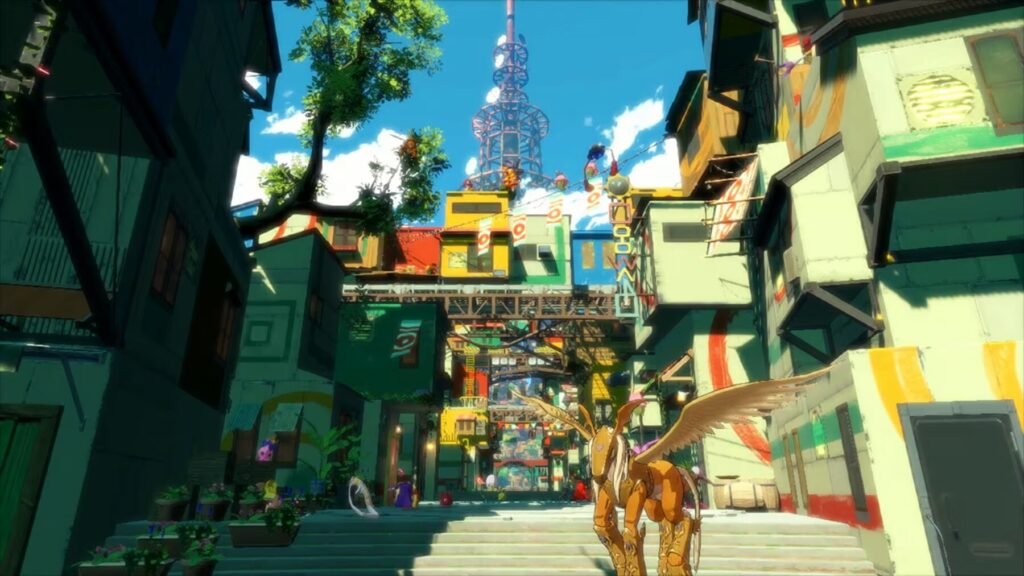
Back to the game’s graphics, the Digimon models are amazing, a clear step up from Cyber Sleuth. The retextures and shading really make the details pop, with things like musculature, fur and feathers really standing out. They look so much more alive, and the Digimon Town was a breath of fresh air. Even the signature attack animations of each ‘mon was something to look forward to. The cityscape and Digital World was well made, and was eye candy to look at with how fresh and vibrant it was.
I loved the DigiRide function, though it took me awhile to figure out that it would default to the first party member with that ability (sadly I can’t ride my GOAT Beelstarmon). Some ‘mons are faster, while some are really quite slow and you’re better off running on your own two feet (I’m sorry Greymon).
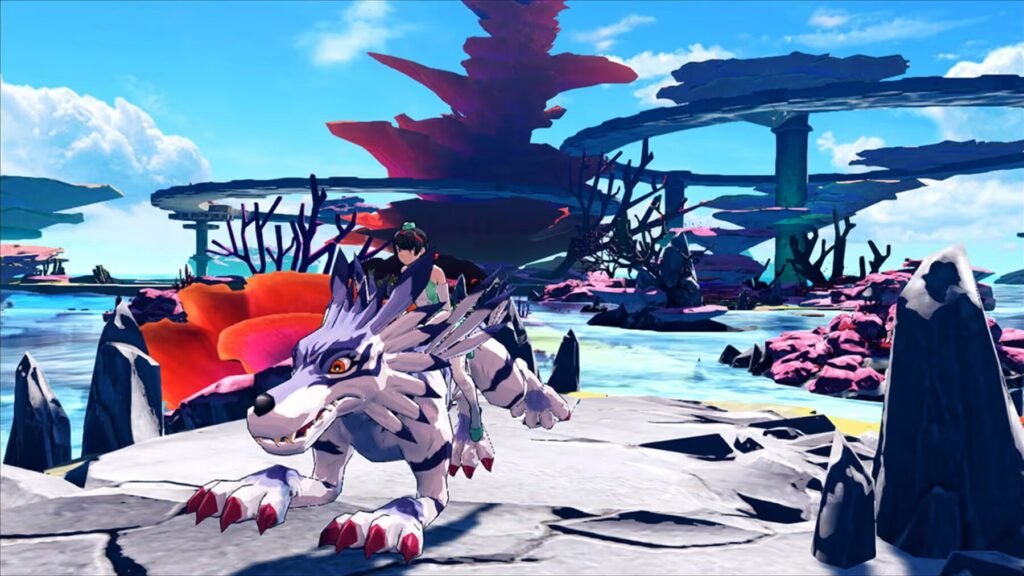
All that said, one minor gripe I have is that the protagonist is silent. I played it with English voice acting, and everyone else is voiced fantastically. Having a silent protagonist sometimes ends up being goofy, as some of the more emotional scenes can fall flat. I do, however, like some of the sillier responses the Agent can give, and play right into their ‘super serious about anomalies happening all over the world’ personality. It’s funny to see other characters being confused or bashing you about it (“This is not the time for a joke!”).
Another point of contention is how complicated raising your Digimons can get, and the game doesn’t explain a lot of things to you in great detail. You end up doing a lot of trial and error, and perhaps making rookie mistakes (hah, see what I did there?) like evolving or devolving your ‘mons too early. It also pained me to see that the white stat growths I patiently raised in the Digifarm would disappear upon devolution – never repeating that mistake again! This is where guides come in handy, if that’s your jam, though I tried to figure out most of what I could first before resorting to them.
One last complaint I have is the ladders in the Digimon Town. I know this sounds like such a weird complaint, but the camera forces a perspective change every time you go up or down a ladder, and it kicks in my motion sickness.
Verdict
Digimon Story Time Stranger is a clear upgrade from its predecessor, and one of the best Digimon RPGs to date. While it has its few hiccups, its time-travelling story is engaging, the Digimon characters are endearing, and you feel invested in them as the story unfolds.
It may get extremely confusing for first-time Digimon players however, especially in how to raise your ‘mons. The grindiness of the game may also be off-putting to those who aren’t familiar with the genre, but with the QOLs in Autobattle and x5 speed, much of the problem is alleviated. I love the progression of this game, and especially love the monster-collecting aspect of it.
My return trip to the Digital World was well worth it, and I recommend newcomers to the series to give this a go too!
This article was contributed by Butterfly, a gamer and cosplayer who’s worked with Mobile Legends: Bang Bang, Flash Vision Esports, and more. You can find more of her work over on Instagram.