





Labyrinth is the latest film from industry titan Shōji Kawamori, the mastermind behind Macross and The Vision of Escaflowne. To most fans, his name instantly conjures the thought of high-flying mecha and soaring orchestral scores – things that should be a treat to see on the silver screen.
This film, Labyrinth, certainly attempts to bring his signature obsessions (idols, love triangles, and tech) into the modern era; however, instead of a timeless masterpiece, we are left with a chaotic, 3D-animated fever dream that feels less like a film and more like a social media-induced panic attack.

At the heart of Labyrinth is Shiori Maezawa, a high school student so crippled by social anxiety that she can only express her true feelings through an anonymous “venting” account. Her best friend, Kirara, is her polar opposite: a social media darling who thrives on the “likes” that Shiori secretly craves and resents.
The inciting incident occurs when Kirara posts an extremely humiliating video of Shiori, which causes her digital and physical worlds to collide – literally. When Shiori’s phone screen cracks, her personality fractures into two distinct entities: “Ideal Shiori”, a confident, pink-and-blue haired doppelgänger who takes over Shiori’s life; while the “real” Shiori is banished to the Labyrinth, a shadowy, Silent Hill-esque parallel dimension within her smartphone.
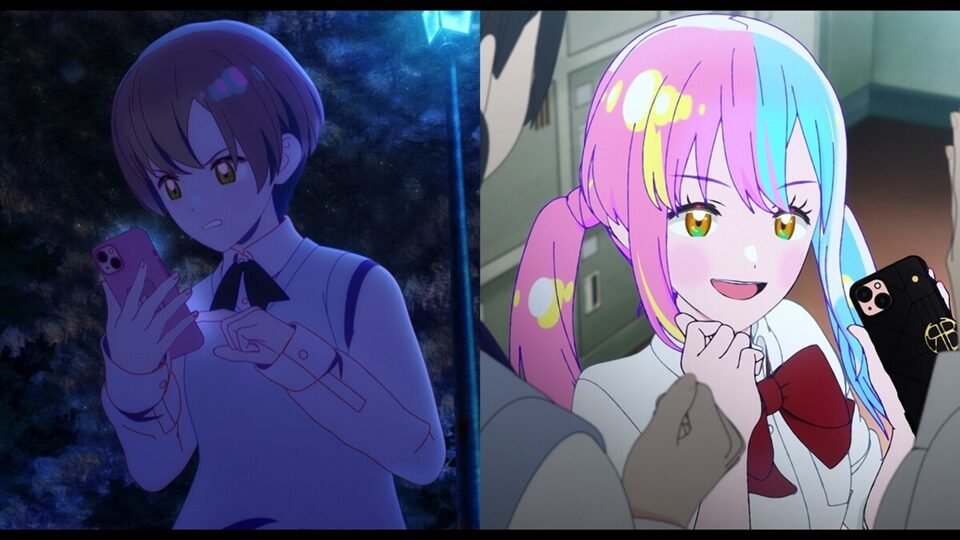
The film’s most imaginative (and arguably most depressing) sequences take place within the Labyrinth. Here, Kawamori explores a literalized version of digital burnout. Without giving too much away, the Labyrinth is populated by “stickers”, people who were once human, but who have now been flattened into smartphone stickers representing their shallowest traits.
If Shiori loses access to her phone, she risks becoming a sticker, and losing her memories of the real world entirely. This does provide a compelling source of tension throughout the film, with there even being a moment where Shiori contemplates giving up her humanity, as she wonders if the real world and all its stresses are even worth returning to. Meanwhile, “Ideal Shiori” sets out to become the ultimate influencer with over 100 million likes, but begins to question if fame is all that it’s cracked up to be.
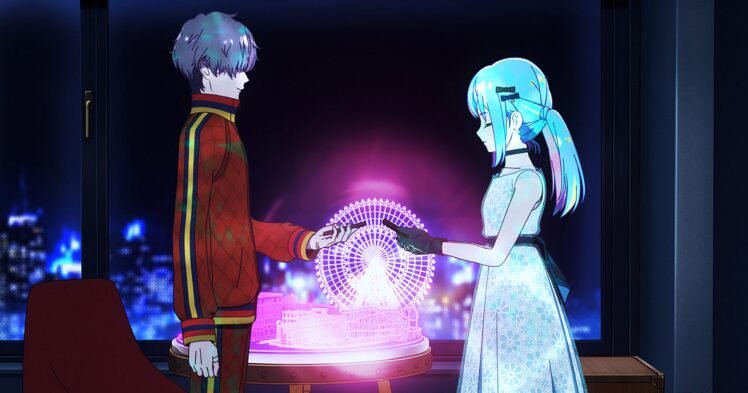
The film ultimately begins to falter when it introduces its villain, Suguru Kagami, an evil producer whose plan to “liberate everyone’s ideal selves” is as convoluted as it is vague. What could have been an interesting commentary on social media addiction turns into a rather bizarre plot to stop him from taking over the world, with more than a few awkward scenes that read as more comedic than sinister, leading to bursts of incredulous laughter from the audience at our screening.
Fans of Kawamori will find his signature tropes in the film, like mecha-adjacent industrial designs and idol musical sequences, but they feel awkwardly stapled onto a story about smartphone apps. It isn’t helped by the occasionally clunky 3DCG animation, which attempts to mimic traditional 2D, but often results in the characters moving with a stiff, doll-like quality. Without the squash and stretch of hand-drawn animation, the emotional weight of Shiori’s plight often gets lost in the Uncanny Valley.

Verdict
Labyrinth is a mess, but it’s a fascinating mess. It is a bloated, two-hour journey through the anxieties of a generation that lives through its screens. While it lacks the narrative cohesion of Macross: Do You Remember Love?, it offers a “WTF” experience that is hard to find in more polished, corporate anime.
For me, personally, I think this would make for a good viewing experience when you’re with a group of friends, perhaps after a few drinks. It’s a little confusing, slightly terrifying, and with a few scenes that are impossible to explain. I would rate this movie a solid 6/10.