




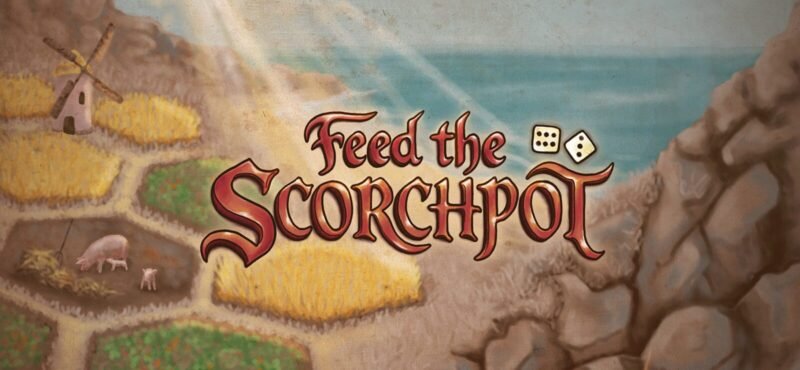
It is not every day that you see a game that blends a videogame and a board game into one beautifully intricate title. The developers at Moravian did that with their newly released game, Feed the Scorchpot, a blend of the Game of the Year-nominated Balatro, and my all-time favourite board game, Catan.
Quite literally, too: the game has a Catan board that requires you to roll dice in order to get high enough of a score to survive the scorn of the dragon, just like hitting the Small or Big blind in Balatro.
As mentioned, the game is simple. You are given a board with multiple hexagons representing “food” that can be produced by placing hamlets in between the hexagons. Each hexagon is represented by numbers from 1 to 12, where you then have to roll the dice and combine two rolls into one number.
For instance, a hexagon with the number 6 requires you to roll and lock a dice with the face number 3 and 3, or face number 2 and 4, for that hexagon to produce the “food” required. Like Balatro, you will also need multipliers to multiply the “food” you get. In this game, that is represented by the spices you collect.
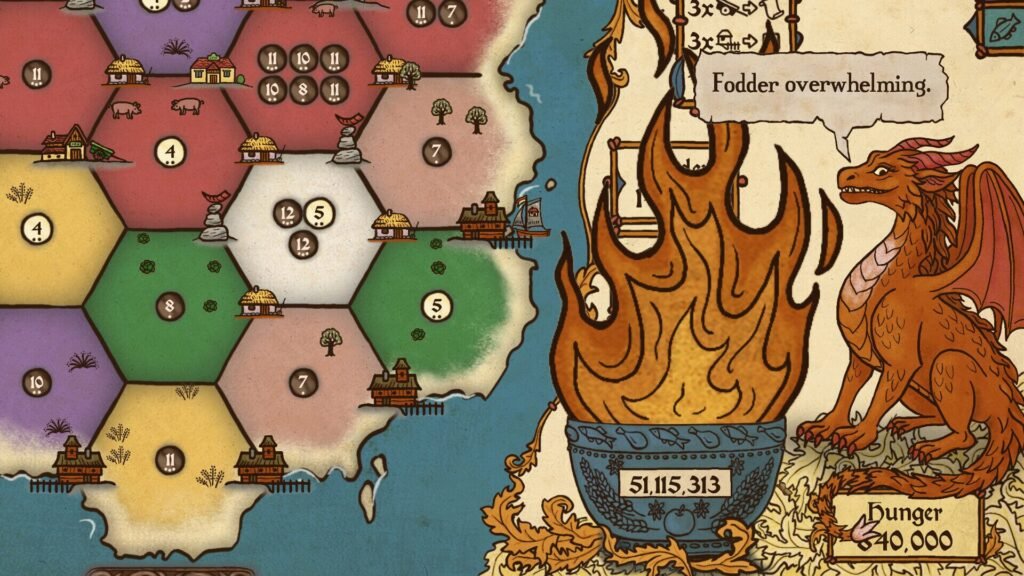
Each year or round is represented by seasons or turns, and you have to collect amounts of “food” equal or more than what the dragon requires, or the dragon will burn the island. At the end of each year, you earn Ducal, which is currency that you can use to purchase items from the shop.
Other than the hamlets that you build, there are also buildings that you can buy from the shop which increases the “food” that you produce, the number of dice you can roll, the spices you can generate and tools that are one time use to affect the board or dice.
I have to say, the game has a low floor where you can learn quickly on what the game requires, but a high ceiling, where you can mix and match things to better strategize.
What I Like
It is two games I love in one, but instead of fighting against other players like in Catan, you are fighting against the Dragon’s hunger like in Balatro. While the Catan aspect may seem simple on the surface, there is a lot of depth as you are able to change the “food” the hexagon provides, change the dice amount required, or even add the dice count to the hexagon.
The Balatro aspect on the other hand provides recipes, in the form of additions and multipliers instead of jokers, and the Dragon’s hunger instead of the Blinds. There is a lot of depth to the game, from the placement of the buildings to your desired rolls, to which items to buy, with many other things to learn along the way.
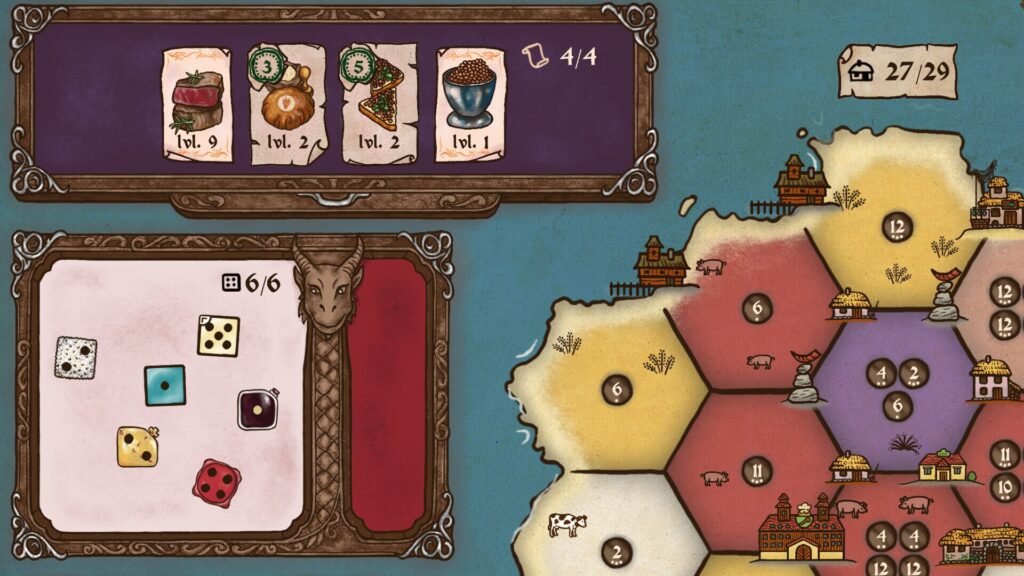
Although there isn’t much to talk about in terms of graphics, the art direction is praiseworthy as it evokes an old-school gaming vibe with its scorched map and little dragons flying in to hunt sea serpents. The whole design of the game is based on medieval art, which reminds me of games like Kingdom Come or Pentiment. The sound design is simple but gets the point across effortlessly, with the rolling dice, the grumbling dragon, the collected “food” and the background music.
There is also a lot of depth to the game, where not only there are buildings, dices, recipes and tools to learn but also dragons, difficulties and your own deck to build to unlock. Each difficulty also changes the rules of the game where you have to relearn how to build your strategy in tackling the random board, dice and items that appear in the shop.
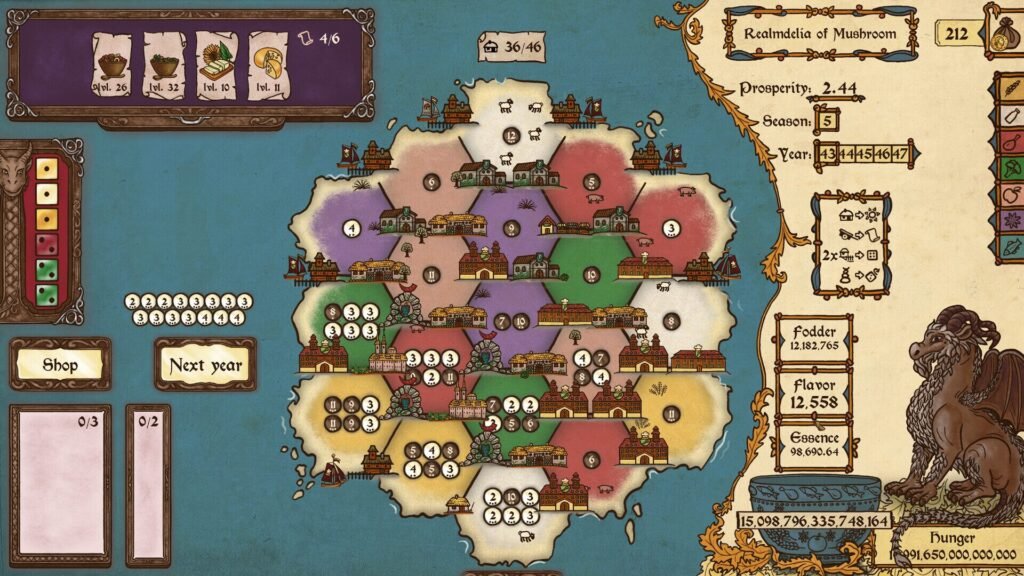
There is plenty of randomization in the game, but it does not hinder you from properly strategizing and planning ahead to reap the most from the dice rolls. You can also lower the randomness of the game by building your own deck of recipes, buildings and dices to assist in your run rather than impede it.
What I Did Not Like
The learning curve is quite steep, especially after the tutorial is over. As I have said, that the game has quite a low floor but a very high ceiling, thus there is a lot to learn from the game, and this might deter a lot of players after one or two failures. There is building placement to learn, which numbers to duplicate or add, which dices to sell and buy, which recipes are best for the “food” that you can reap and other lessons to learn along the way.
This learning curve will be the hallmark of whether a player would stay to continue playing adding more and more difficulty or running a few games before moving on to other games. I do hope in the future that the developers would lower the difficulty of the first dragon or expand the tutorial to include more in-depth lessons rather than just the basics of what the game does.
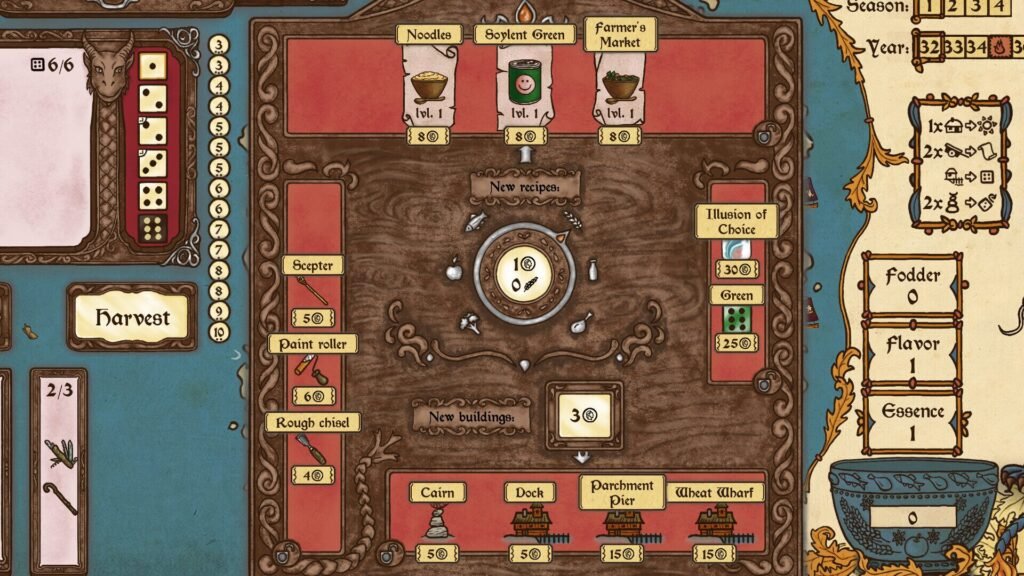
The randomization, although a boon to the game in giving it replayability, can be a curse as well. There is a vast difference between getting a good start with excellent placement of hexagons and what is available in the shop, and a bad start where even your placement of buildings or the shop cannot save you.
There is also a random element to the Wrath of the Dragon, where some wraths are more lenient than others, which could determine whether your run continues or ends there and then. Still, like I have said, the randomization does not hinder your progress of the game and although it can decide a run, some strategies and planning can curb the randomness by a lot. Plus, you can always put in a good seed to have a good run regardless of the randomization of the board or shop.
Conclusion
This is a great game that you can get for below RM40 (15USD) and play for hours without end. The randomness, in my opinion, just adds a layer to the difficulty and depth, which can be a boon for some, while a curse for others.
I hope that more videogames would try to blend the boardgame space with the digital space, rather than directly digitalizing a board game. Overall, an 8 out of 10 pies for me for the type of game it is, and for how long I will be playing it.