




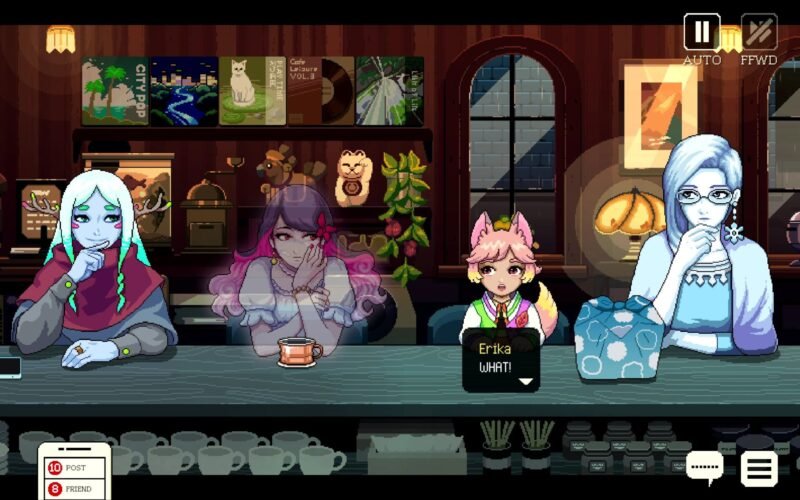
Coffee Talk Tokyo is the third installment in the narrative megahit series Coffee Talk. Developed by Chorus Worldwide in conjunction with Toge Productions, the game is set in a totally new region (Tokyo, if you couldn’t tell from the title) with a totally new cast of characters. While some of the old cast do make an appearance as social media posts, the new cast of characters brings a new set of story arcs, personalities to fawn over, and new drinks to brew, with some fan favorites making a comeback.
The game hits all the right notes following its predecessors. The characters are fun to engage with, the story is in-depth with a hint of realism and fantasy, and the art feels like it’s had a slight upgrade, with new expression types for each character and more cute decorations that fill the shop. With this edition of Coffee Talk being led by Chorus Worldwide, with Toge Productions, the original main developers of the first two games, assisting and guiding the development, the overall story beats and underlying tones do feel slightly distinct in this edition. Given that the game is set in Tokyo, it still does a wonderful job of blending the lore of Coffee Talk with the culture of Japan.
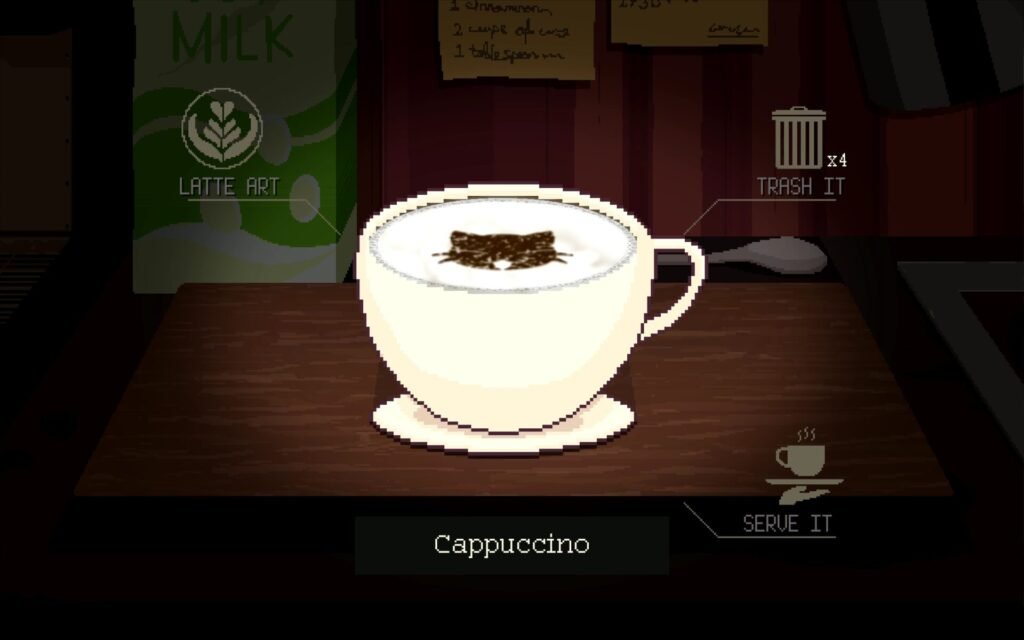
Let’s start with the very first thing you notice when you boot up the game: the music. Andrew Jeremy, the composer of the first two Coffee Talk games, returns for Coffee Talk Tokyo with music that has a nice new tone, while still maintaining a similar vibe and rhythm to the originals. The spirit of the game genuinely felt elevated by the background ambience and music, but, to be honest, throughout my playthrough, I didn’t think much about the music at all – though not in a bad way. My brain just subconsciously registered the background music as the kind of coffee shop music you hear passively. It is honestly one of the better “lo-fi beats to something” playlists to just lose yourself in, both in-game and when you simply want some lo-fi beats to work to.
Now, the main reason to love the series: the characters and their stories. The game introduces 11 new characters, each with their own quirks, history, ambitions, and flaws. As a whole, the characters and the stories shared throughout the game are greatly written and feel real and cohesive, but on an individual level is where things start to reveal some cracks. Before going deeper into that, there is one overall story arc that does feel a little off, which I’ll be explaining in a little more detail, and thus, this is an early-game spoiler. (Skip to the section under the image if you wish to avoid being spoiled.)
Coffee Talk Tokyo introduces a ghost character named Ayame and her “caretaker,” Fuku, who is tasked with helping Ayame solve her unresolved business before passing on. The sudden introduction of ghosts can be forgiven; after all, this world is filled with humanoid werewolves and vampires. However, it also introduces a government agency whose duty is to help spirits and ghosts pass on. This feels very left-field, as it introduces both the concept of ghosts and an afterlife of sorts into the world.
With Coffee Talk Tokyo set in the same world as the first two games – not just in name but within the series’ canon, since the first person you talk to is Hendry – it opens up questions about what an afterlife is in the Coffee Talk world, especially regarding Riona, a banshee from the second game. While I understand that the concept and relationship of spirits are strongly tied to Japanese culture, I felt that the idea of a spiritual government agency was a weak addition to the series.
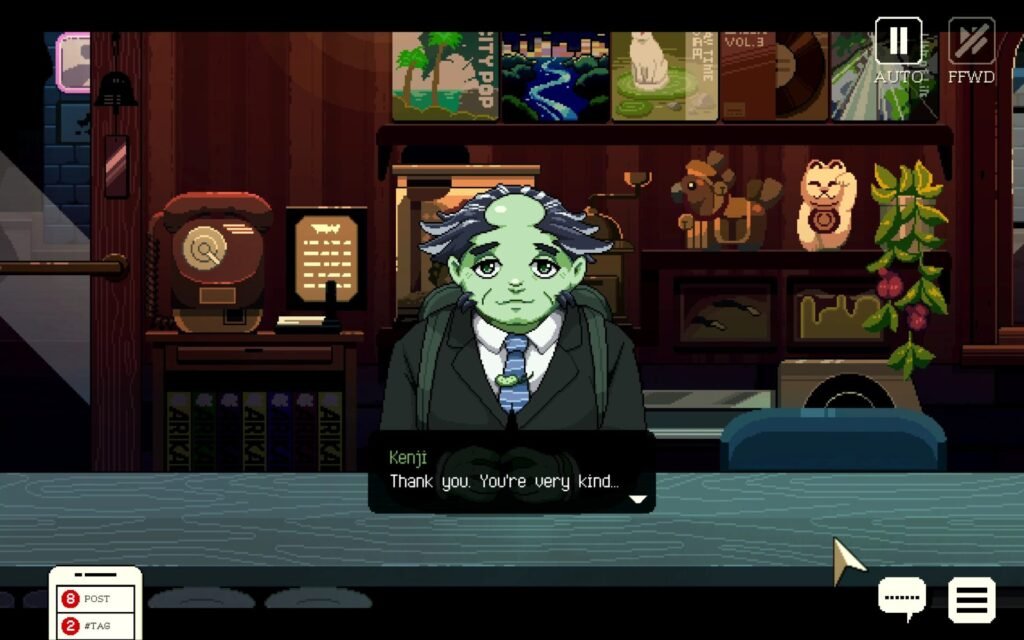
In regard to the characters, though, their personalities and stories do shine quite nicely throughout the game. The relationships between characters unwind slowly yet naturally as both the players and the other characters learn about each other. From the heated arguments to the heartbreaks and honest conversations, I truly enjoyed my time learning about the relationships that blossom between them.
What felt missing at times was their individuality. Some characters felt like they were written in the same voice, without their own unique slang or tone. While there are moments that highlight certain characters’ traits greatly, there are a few that highlight them in a weird way, making me question their believability as characters in this world. An example of this would be Character A suddenly agreeing with Character B, even though Character B hardly made a good argument – or an argument to begin with. For that reason, it was hard to maintain the suspension of disbelief that I was playing a game. Instead, it made me feel like I was reading an early manuscript of sorts.
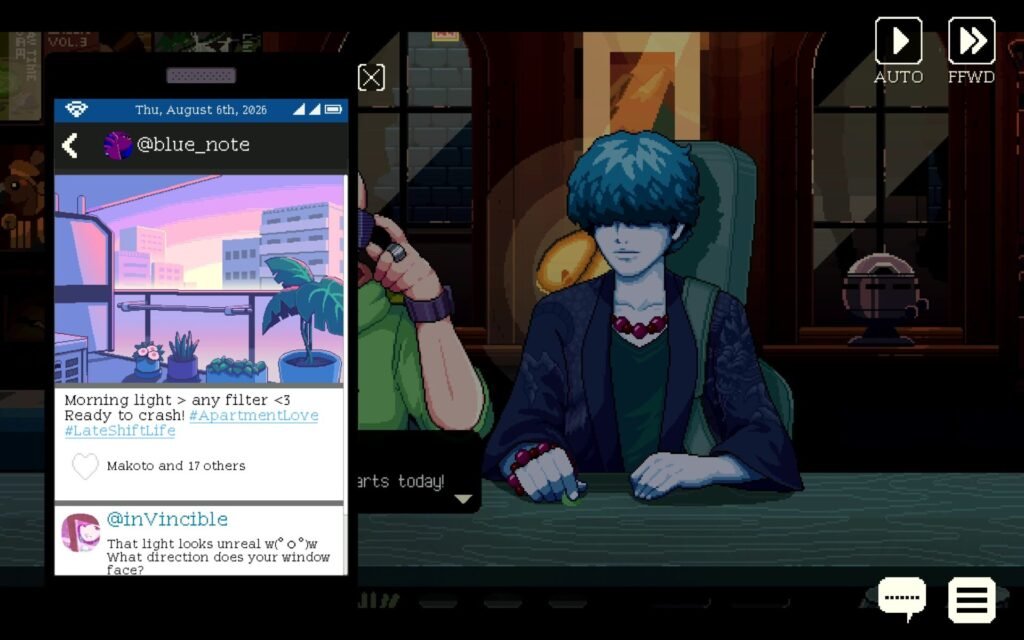
Being part of the Coffee Talk series, the game brings back its in-game social media app. Tomodachill 2.0, the game’s social app, acts as an additional layer for players to read and check in with their patrons to see what they have been up to outside of the shop. It adds a nice personal touch to see their own thoughts outside of the conversations you partake in. In Coffee Talk Tokyo’s case, one of your regular customers has a semi-celebrity status. You can actually follow his personal account, where you get a more personal side of his thoughts and struggles. If you’ve ever followed someone’s personal private account, it’s very much the same vibe in terms of its content.
While the additional content to learn more about each regular is always a nice touch, it does falter in terms of the user experience. Unlike the previous two Coffee Talk games, notifications in Tomodachill 2.0 only go away when you click into each post. This means that if you go through Tomodachill without clicking on an individual post, throughout the whole day there will be a red circle at the bottom left of your screen constantly, which can get annoying to deal with.
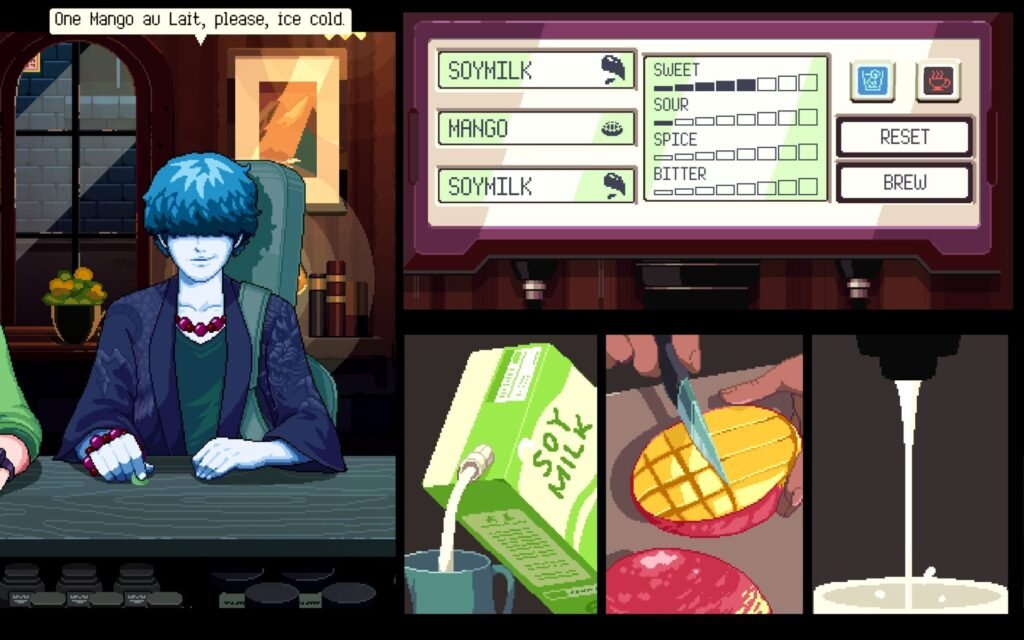
This itself still isn’t really an issue. What makes it really irritating is that Tomodachill 2.0 also introduces hashtags, allowing you to read random users’ posts that share the same hashtags. While it does add some nice worldbuilding by showing what the general public is thinking or talking about, it becomes especially annoying when you have 10 or so hashtags that you have to click on just to remove notifications.
Additionally, you can’t speed-run your way through the “Hashtag” tab’s notifications because every time you click into a hashtag, it brings you back to the first hashtag, at least while playing on a controller. While it’s a minor issue, it still gets annoying to deal with after some time.
Verdict: 7.5/10
Overall, the vibes and feel of the game hit the right notes for a lovely experience. The music is warm and cozy, the art feels like an upgrade, and the different stories are unique and harmonize well.
What does feel like a bit of a miss are the characters as individuals. They feel a little flatter in their dialogue, their background lore does feel a little out of place sometimes, the writing feels too similar between them, and the extra small ingredients that made the previous Coffee Talk games unforgettable just feel missing.
Coffee Talk Tokyo is still worthwhile picking up if you are craving more from the universe, but it might be better to get into it for the story-rich world rather than the characters themselves.