





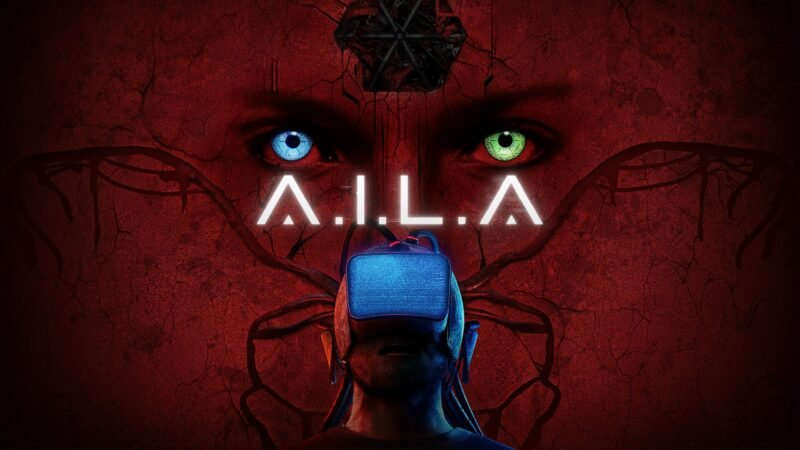
Set in a near-future filled with immersive technology, you play as the sole game tester for a revolutionary new fictional AI named A.I.L.A. Survive intense horror experiences that prey on your deepest fears as the lines between virtual and reality begin to blur.
Developed by: Pulsatrix Studios
Played on: Steam
Length: 9 hours
A review key was provided by Fireshine Games
The horror genre is no stranger to rogue artificial intelligence, but the timing couldn’t be more apt for a game like this. From Brazilian-based Pulsatrix Studios, their second title A.I.L.A. puts you in the shoes of a game tester for a revolutionary A.I. program that designs horror experiences based on your greatest fears. I’d personally been following this title for awhile now, but I went into it not knowing what to expect.
Was it going to quiz me on my fears? Were the scares actually going to adjust to my playstyle? Could I expect a completely unique experience compared to other players? The simple answer is no, but that’s not entirely a bad thing.

It’s clear almost immediately that the game tells a, mostly, linear story. You play as Samuel, a typical horror game protagonist with more than a few troubles weighing on his mind, despite his lavish penthouse apartment and adorable pet cat. He carries these hidden traumas into each horror experience that we play, although we don’t quite understand the full extent of it until they reveal more about his backstory later.
The premise of “game testing” ends up being a lot of fun in practice. Through its 9-hour playtime, we get to experience a wide range of game levels that explore the horror genre’s most common settings and mechanics; from facing down zombies and bog witches, to referencing mechanics from Silent Hill PT and Resident Evil. Sometimes the levels even stretch on for so long that you forget that you’re playing a game within a game, which really messes with your head in a meta way.
This also means that the game doesn’t innovate on its own mechanics, but it doesn’t really need to. Each level borrows familiar mechanics that seasoned horror gamers will be able to jump right into, and despite the massive map size for certain levels, the complexity of its gameplay and puzzles are simpler than average; perhaps bearing in mind that each level is still a game within a game. Beyond a few minor hitches, like the one time I couldn’t find a key item that blended a little too well into the environment, my overall experience was smooth.

That being said, the novelty of this game is also what takes me out of the experience a little. While the game sells you on the A.I. adjusting to your fears, this is one of the times I wouldn’t buy into the marketing. There is a definite sense of detachment from the scare factor knowing that we’re playing as a separate character with their own personality and motives. Not to mention, the game opts for a broad strokes approach to its horror settings which makes the scares in each level a hit or miss depending on the player.
There is some attempt to add stakes to the player’s choices through its karmic system, which impacts the final ending of the game. However, the impact of your choices aren’t felt as you’re making them, so it’s hard to tell whether you’re moving the needle in the right direction until you reach the very end.
But credit where credit’s due, A.I.L.A. tells an intriguing story that only gets better the further you get into it. Without spoiling anything, I’m a huge fan of horror games that confront the uglier sides of humanity, and while the game doesn’t exactly tell a unique story, it does present enough twists and turns to leave you deep in contemplation by the end of it.
As a side note, warning to players with photosensitive epilepsy as there are certain sequences that get pretty rough. I don’t typically have issues with this, but even I found the ending sequence painful to get through, and an accessibility feature to tone this down would have been much appreciated.

Verdict: A Positive A.I. Experience
The horror genre is no stranger to rogue artificial intelligence, but the timing couldn’t be more apt for a game like this. Pulsatrix Studios’ second title is a love letter to horror classics, executed in Inception-like fashion where each level is a game in a game. While it doesn’t tell a story we haven’t heard before, it does present enough twists and turns to leave you deep in contemplation by the end of it.