



You loaded into Orbis, picked a fight with a bear, and got absolutely wrecked. Hytale’s combat system runs much deeper than it first appears. Button-mashing will get you killed before you leave Zone 1. With stamina management, weapon-specific movesets, and enemies that adapt to your playstyle, there’s much more going on beneath the surface. Here’s everything you need to know.
Skill Over Gear: How Hytale Combat Works
If you’re coming from Minecraft, the biggest adjustment is this: Hytale rewards how you fight, not just what you’re holding. A player with a copper sword and excellent timing can outperform someone swinging an adamantite weapon recklessly.
There are no locked character classes. Your weapon is your class. Pick up a sword, and you’re a balanced, versatile fighter. Grab daggers, and you become a hit-and-run specialist. Switch to a mace, and suddenly you’re sending enemies flying off ledges.
Every weapon type has its rhythm, combos, charged attacks, and signature moves. Finding one that fits your playstyle matters more than chasing raw damage numbers.
Three core systems drive every fight in Hytale:
- Stamina fuels sprinting, charged attacks, and dodge rolls. It regenerates quickly in Early Access; using it completely drains your energy, triggering an exhaustion state where you can’t block, sprint, or dodge. Getting caught in this state while surrounded by a mob means certain death.
- Charged attacks are activated by holding the attack button, and each weapon has a unique one. Swords dash forward. Battleaxes deliver a downward slam. Daggers launch into a pouncing stab. The golden rule: these aren’t openers. They are follow-ups after an enemy misses.
- Dodge rolls cost stamina but grant invincibility frames during the animation, letting you reposition mid-fight against enemies with wide swings or when you’re surrounded.
Every Weapon Type Broken Down
Hytale currently features six completed weapon categories, each with a primary attack, secondary attack, block, and ultimate ability.
| Weapon | Speed | Best For | Signature Move |
| Sword | Medium | All-around use, shield pairing | Whirlwind slash |
| Daggers | Very fast | Hit-and-run, mobility | Quick escape dash |
| Battleaxe | Slow | Crowd control, big damage | Spinning whirlwind |
| Mace | Slow | Knockback, staggering | Jumping slam |
| Bow | Ranged | Kiting, safe damage | Triple shot |
| Crossbow | Ranged | Burst damage, openers | Power shot |
Beyond these, staves, wands, guns, and clubs exist in-game but remain works in progress. Elemental staves can already be tested through the Arcanist Table, consuming essences as ammo.
For players exploring all of these items with friends, having a stable multiplayer environment makes a real difference. Reliable Hytale hosting keeps co-op sessions smooth so you can actually focus on learning combat mechanics instead of fighting lag. Dedicated servers help reduce lag and improve gameplay stability.
One standout mechanic is Signature Energy. As you land attacks, a blue gauge fills around your special attack icon. Once full, press Q to unleash your weapon’s ultimate. But switching weapons before using it resets the gauge entirely, so commit to one weapon per fight if you want access to your strongest ability.
Armor and Defense
Your armor includes a helmet, gloves, chestplate, and greaves. Each piece boosts your health pool and may add combat-relevant stats. Materials follow the same progression as weapons: copper, iron, cobalt/thorium, and adamantite at the top.
Shields paired with one-handed weapons create a defensive playstyle, similar to the deliberate melee combat found in Soulframe, that lets you control fight pacing. Guard, wait for openings, then counterattack. Repeat. This strategy works especially well in PvP, though over-guarding drains stamina quickly.
Crafting higher-tier gear requires upgrading your smithing stations through three tiers, each demanding zone-specific materials like ice essences from blue-eyed enemies in the Whispering Frost Frontiers and fire essences from deep cave mobs in the Devastated Lands.
Enemies Across All Four Zones
Orbis is divided into four zones that scale in difficulty, each with a distinct roster of hostile mobs.
| Zone | Region | Key Threats | Watch Out For |
| Zone 1 | Emerald Grove | Trorks, wolves, bears, cave spiders, skeletons | Trorks flank and mix melee with ranged pressure |
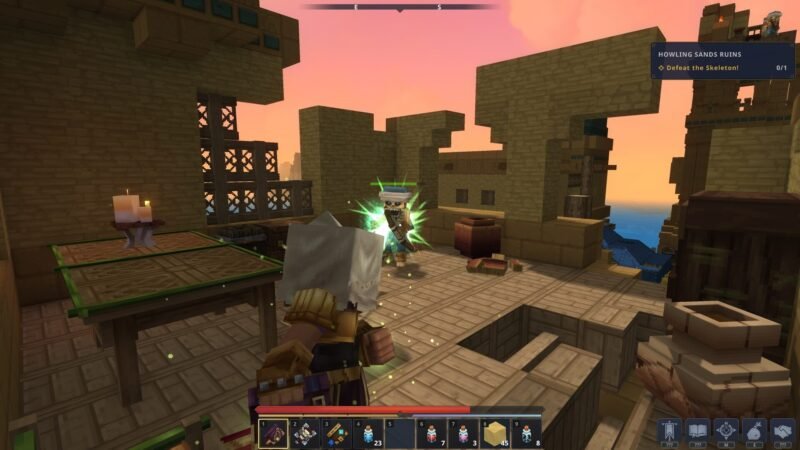
| Zone 2 | Howling Sands | Sand skeleton archers/mages, Scarak swarms, hyenas, scorpions | Ranged enemies that kite backwards |
| Zone 3 | Whisperfrost Frontiers | Outlanders, wolves, Void Spectres | Outlanders swap weapons and pull extra mobs |
| Zone 4 | Devastated Lands | Ember Golems, Bleached Hounds, Voidspawns, dinosaurs | Wide area attacks and underground jungle predators |
The biggest mistake beginners make in Zone 1 is fighting near tight terrain where repositioning is difficult. By Zone 3, the Outlander groups become the main threat.
They kite, swap weapons mid-fight, and pull additional enemies into encounters. Zone 4 is the current endgame and features dinosaurs, elemental golems, and underground jungle predators that punish anyone who treats it like a normal biome. Surviving in Zone 4 requires careful planning and strategy.
Boss Fights and Smart Enemy AI
Bosses require learning telegraphed attack patterns and timing your responses. The Stone Guardian in the Forgotten Temple is most players’ first major boss. It hits hard and has anti-cheese mechanics. Pure ranged kiting doesn’t work well, so you need to get comfortable fighting up close.
Some practical boss tips that work right now:
- Bear traps completely freeze the boss AI’s pathfinding, allowing for free hits.
- Popcorn gives an instant 15% heal mid-fight
- Daggers can stun-lock most enemies with swift knockback attacks (likely to be addressed in a future patch)
- Basic meals provide regen over time, so eat one before engaging
What really sets Hytale apart is its Combat Action Evaluator system. Unlike the threat-based AI seen in traditional survival games, enemies here don’t just rush at you blindly. It evaluates the number of opponents, analyzes your behavior, checks its health, and adjusts tactics accordingly. Enemies can switch weapons mid-fight and time special attacks for maximum impact.
During internal testing at Hypixel Studios, an NPC wielding a sword and shield successfully competed with a real human player, which helped Hytale become one of the most-watched games on Twitch during its launch week. This is why terrain matters so much. A mace-wielding Trork near a cliff will absolutely try to knock you off. The environment isn’t just scenery. It’s a tactical factor that both sides use.
FAQ
What weapon should beginners pick in Hytale?
Swords are the most forgiving: balanced speed, decent damage, and shield compatibility. Bows work well if you prefer keeping your distance while learning. Pick what feels natural and upgrade from there.
Does Hytale have character classes?
No. Your weapon, armor, and gear define your role. You can switch playstyles any time by swapping your loadout.
How does Signature Energy work?
Land attacks to fill the blue gauge, then press Q for your weapon’s ultimate move. Switching weapons resets it completely.
Can Hytale enemies adapt to your playstyle?
Yes. The Combat Action Evaluator lets AI analyze situations, switch weapons, reposition, and time special attacks based on player behavior.
Is Hytale PvP skill-based or gear-based?
Primarily skill-based. Hypixel Studios has confirmed no pay-to-win mechanics or level-based PvP advantages. Timing, positioning, and reading opponents win fights.
Key Takeaways
- Upgrade weapons first, always bring food, and learn enemy instructions to dramatically improve your survival rate.
- Your weapon choice functions as your class, offering total flexibility with no locked roles.
- Stamina management is critical. Exhaustion leaves you completely vulnerable.
- Six weapon types are fully complete, each with unique combos, charged attacks, and signature ultimates.
- Enemies scale across four zones, from Trorks in Zone 1 to intelligent Outlander groups and Elemental Golems in later areas.
- Hytale’s AI evaluates your behavior and adapts mid-fight, making positioning and terrain awareness essential.