






I recently had the pleasure of spending a weekend playing Abra-Cooking-Dabra, a card-based cooking game that blends resource management and puzzle mechanics. The third game developed by British studio Door 407, Abra-Cooking-Dabra expands on their catalogue of strategy games (previous titles include Diplomacy is Not an Option and URBO), somehow managing to capture both the hectic high-volume order fulfilment of Overcooked and the calm, almost therapeutic card arrangement of Solitaire.
Set in London, you play as a chef struggling to come up with a new menu for your restaurant late one night – when suddenly, you receive a strangely specific email that promises to solve your exact problem! Upon clicking on it, you are immediately whisked away into a Wonderland-like realm (accompanied, of course, by an ominous magical Cat) where you then undergo a series of trials preparing various British dishes for waves of eccentric customers.
Abra-Cooking-Dabra delivers a steady drip-feed of increasingly chaotic card-stacking gameplay over the course of its 10+ hour runtime spanning 26 levels (not counting bonus “secret” levels), gradually ramping up the challenge as you progress. Recipes get more complex, requiring more ingredients, intermediary steps, and more specialized tools to prepare them.
Customers need more dishes to be satisfied, and some “boss” customers even have countdown timers that trigger debuffs to get in your way, such as obscuring the faces of the cards (forcing you to work off of memory), turning off the lights, or even blowing your cards all over the board.
Central to Abra-Cooking-Dabra’s gameplay is the management of its primary resource: space. It essentially forces you into an interesting tradeoff where you “suffer from success” – the more coins you earn, the more recipes and kitchen upgrades you unlock, the more they take up your available workspace.
Upgrades stay with you permanently, too: you can go back and replay any level with all of the equipment and boosts you collect throughout the game. Effectively organizing your kitchen, then, is more critical than cosmetic in Abra-Cooking-Dabra: the bulk of the game experience consists of constantly shifting things around to make room.
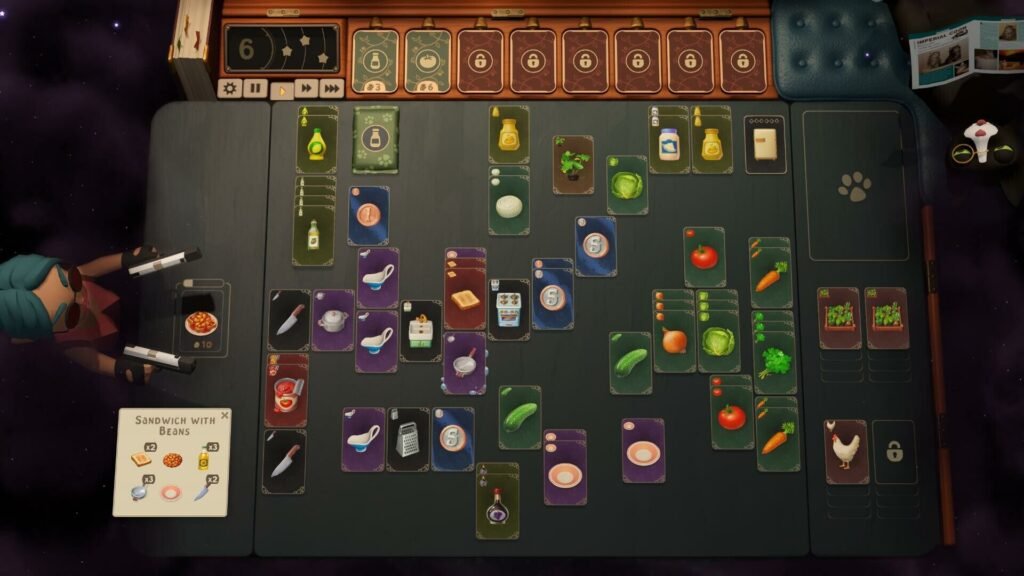
What I found most interesting was Door 407’s approach to the puzzle element that the game is marketed with – simply put, the fact that the game itself is kind of the puzzle. Abra-Cooking-Dabra takes an incredibly minimalist approach to presenting its mechanics, often dropping you right into the gameplay with little to no explanation at all – you kind of just… figure things out as you play around. For example, in the very first level (similar to most of the other levels), the game only gives you explicit instructions twice:
- Once at the start of the first level, when the game tells you to click on a customer’s order to pin the recipe on screen (a nifty quality-of-life feature); and
- Once at the end of the level (and in fact, every level), when the game tells you to stash leftover ingredients in the fridge to be carried forward to the next level.
Everything else in between (such as the core mechanics), the game leaves you to figure out completely on your own, such as:
- Clicking on card packs to open them and draw a card;
- Moving cards around on your board and combining them in stacks (how recipes are formed);
- The game’s time mechanic, where you can pause and control the flow of time (moving forward at 1x, 2x, or 4x speed);
- Processing/cooking ingredient cards by dragging them on top of your utensil cards (such as the knife);
- What steps you even need to perform to your ingredients to fulfil the recipes (you have to infer from either the nature of the ingredient itself or examining the recipes closely);
- Fulfilling orders by dragging completed dishes in front of customers;
- Selling extra ingredients to earn coins;
- Purchasing ingredient card packs with coins earned, to name a few.

I found this approach to tutorialization pretty positive overall: it certainly made my engagement with the game a lot more active, since I had to deduce the workings and subtleties of the various game mechanics via some trial and error.
The open-endedness resulting from the game not outright telling you everything also lends to an air of creative freedom: you’re have complete control over how you organize your workspace, and later stages of the game even let you freestyle orders using recipes you’ve learned previously (e.g. “Make any dessert”).
That being said, the game is not without its frustrations. The RNG-based aspect of buying ingredient packs did prove to be frustrating at times. To its credit, the game does try to balance this over a wide variety of ingredient types, but it was definitely felt more strongly in certain areas – for example, after the introduction of cooking oil as an ingredient. It’s much more heavily needed than the other sauces (as a prerequisite for frying any food), and yet it only drops about ⅙ of the time.
Thankfully, with the ability to pause the flow of time, this didn’t really have a significantly negative gameplay impact beyond minor tedium and a speed bump in the overall flow of the game.
Verdict: Sim-Salad-Bim (The Devs Cooked)
Abra-Cooking-Dabra paradoxically offers both hectic Overcooked-like order management and relaxing creative card-arranging gameplay, all wrapped in a distinctly stylish “Wonderland gambling den” visual aesthetic. As a puzzler, the sheer amount of information that the game is able to convey to you simply by letting you play around with minimal direction speaks volumes to the level of intuitive game design on display.
Save for some mildly frustrating RNG (cough cough cooking oil), Door 407 delivers a delightfully polished product, and I’m intrigued to see what they come up with next.
This article was contributed by Fjordyboy, an avid indie game enthusiast, content creator, and member of The Cham Drinkers. You can find him on various platforms (linked here).