

Studio Orange is one of the world’s leading 3D animation studios, known for their work on anime series such as Land of the Lustrous, Beastars, Trigun Stampede, and the upcoming Trigun Stargaze. They recently appeared at AniManGaki 2025, where the studio held educational panels, meet-and-greets, and even a mini artwork exhibition.
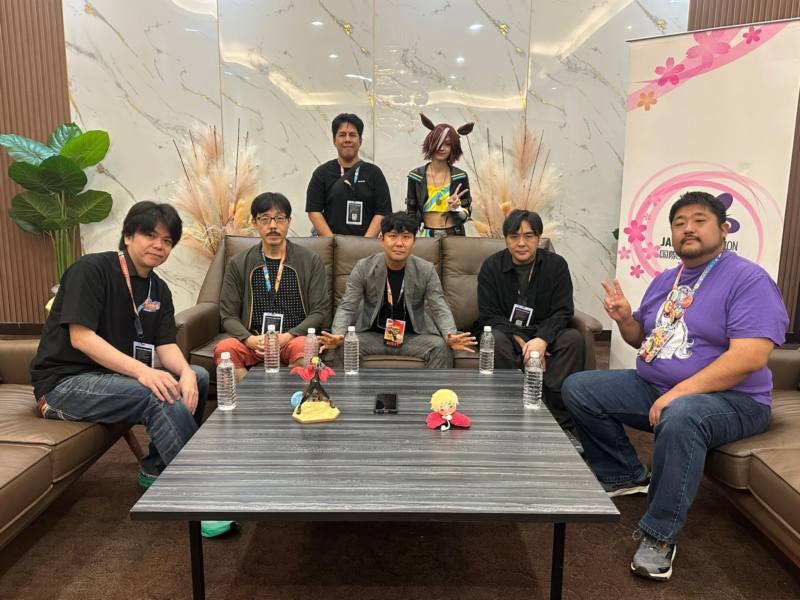
We got to meet a few members from Trigun Stampede’s creative team, including director Kenji Muto, character designer Yumihiko Amano, mechanical designer Fumihiko Katagai, and producer Yoshihiro Watanabe, as well as figurine sculptor Tatsuya Hattori, who designed the Trigun Stampede ARTFX J lineup for Kotobukiya. Although we were only able to ask them a few questions due to time constraints, it was still an honour to speak to such esteemed members of the industry.
Disclaimer: The following interview has been edited for clarity and ease of reading.
For Kenji Muto, you’ve previously worked on series such as Land of the Lustrous, Beastars and Trigun Stampede, which are adaptations of popular manga. As a director, what are some things you always keep in mind when translating manga pages to animation, particularly in 3D animation?
Kenji Muto: For Land of the Lustrous and Beastars, I was only involved as an episode director. In that case, as I was working for another director, I was just adapting the product one-to-one. But in the case of Trigun Stampede, with discussion from Nightow-sensei and the producers, the original concept was to restructure and recreate this property into anime. So there was a different approach to that.
Compared to other shows, it’s different in that we took apart the elements of the original comic first, and then restructured it from there on. So that’s the different approach that we took, as we can’t take it apart to the point that we break it.
For both Yumihiko Amano and Fumihiko Katagai, what are some differences between designing characters and machinery for 2D versus 3D animation? Do you have a particular preference for either medium?
Fumihiko Katagai: For hand-drawn and 3D animation, there’s not really a big difference in regards to mechanical designs, because even in hand-drawn animation these days, a lot of mechanical scenes use 3D models. But in older times, when we were creating for fully hand-drawn animation, there were a lot of cautionary things not to do, or notes that were given to reflect onto our designs, and those kind of notes are all still reflected to current times as well.
Some of those notes would include things like not having too many details, such as having too many holes in the designs of things, as it tends to lose the silhouette. It’s a distraction that detracts from the silhouette of the design. So we try to focus on the silhouette of things, instead of having too much detail.
Yumihiko Amano: I don’t really watch too much 3D anime, so I don’t really keep in mind that I’m designing for 3D or 2D animation. But in regards to that, watching Trigun Stampede, I was amazed at what 3D anime can do.
For Yoshihiro Watanabe, you recently worked as a producer for Leviathan, which is an adaption of an American novel. Are there any differences between adapting works for Japanese and American authors, and would you be interested in adapting works from authors of other cultures?
Yoshihiro Watanabe: In regards to adapting Leviathan, Scott Westerfeld is an amazing author to work with. I felt that, when working with him, we exchanged a lot of opinions on how to adapt his series into anime. What we did was we adapted three books into twelve episodes, so we had to compress a lot of things. But, like with Trigun Stampede, we took apart the original novel and we looked at each element, and we felt that in order to tell the main character’s story, we needed these incidents from the books to happen. So that’s how we structured Leviathan.
In regards to if it’s Western or not, it’s not really too much of a focus, but we do tend to look at and try to understand different elements that resonate with people around the world. We would like to adapt any story. It doesn’t matter if it’s Japanese, or American, or any other story. As long as it has a strong story, we would like to work on adapting it.
Learn more about Studio Orange via their official website, or follow them on Facebook, Twitter, and Instagram.
This interview was made possible with the support of The Japan Foundation, Kuala Lumpur.