



A gritty dice-driven RPG, in a steampunk city. You escaped the War, but how to survive? Explore the city. Build up your skills. Decide who to trust. Choose carefully: you might just spark a revolution!
Developed by: Clockwork Bird
Played on: Steam
Length: 8 hours
A review key was provided by Future Friends Games.
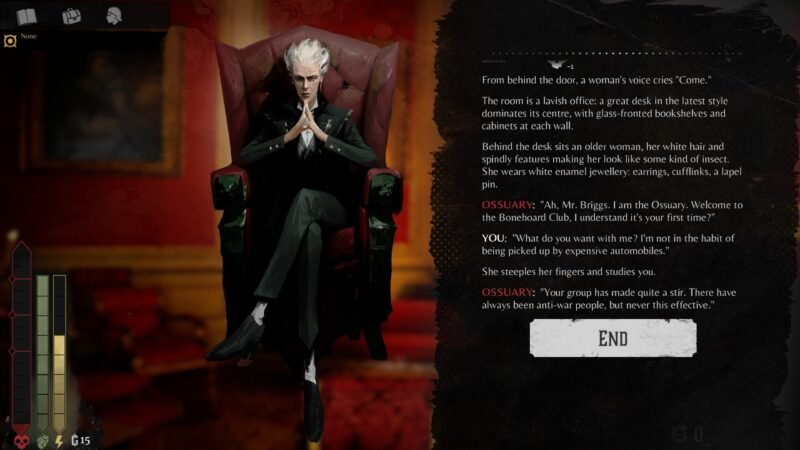
If you’re a fan of Citizen Sleeper, and you’re looking for the next dice-based narrative to tide you over until the next one, Duskpunk might be exactly what you need. Set in dreary Dredgeport, a steampunk city on the brink of destruction or revolution, you play as an ex-soldier who is shipped back from the front lines when you’re mistaken for dead. After a narrow escape, you find yourself alone in the guts of the city with only one goal: to survive.
Text-based games like Duskpunk live and die by their ability to immerse you in the world they’ve created. In this case, it is the strength of game writer James Patton that draws me into this bleak yet familiar world. There are plenty of elements and themes in Duskpunk that we’ve seen expressed in other works of fiction, almost to a tired extent, but the combination of entrancing writing and a compelling personal narrative makes all the difference.
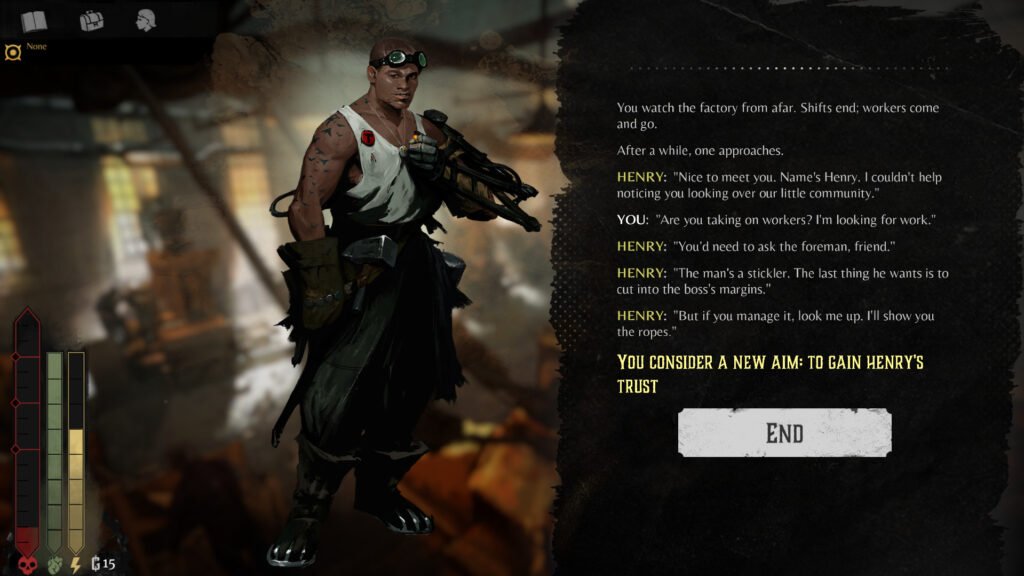
As the main character, you start the game at rock bottom. With an injured foot, no means to earn a living, and the law chasing your trail from the frontlines, your odds of survival are slim. Forced to beg and steal in order to keep your belly warm at night, you slowly work your way up through the city, even if it means having to skirt the law or make friends with unsavoury characters along the way.
With most faction-based narratives, there’s almost always a pressure to commit far too early. It feels like you barely get to know each faction and their leaders before you’re forced to lock in an answer that will follow you for the rest of the game. In that regard, Duskpunk is delightfully non-committal and well-paced. You get to spend more than enough time with each faction, learn their backstories and motives, and even work towards their goals without being punished by the game.
If you’re good enough at keeping your lies straight, the game even rewards you for sticking your fingers into multiple pots. You can act as a double agent for multiple factions while earning all the benefits in money and loot, so long as you never reveal your true loyalties. That doesn’t mean your choices don’t carry any weight, because the game does a good job of adding consequences to every choice, but it does empower the player to play by their own principles rather than blindly following the values of their chosen faction.
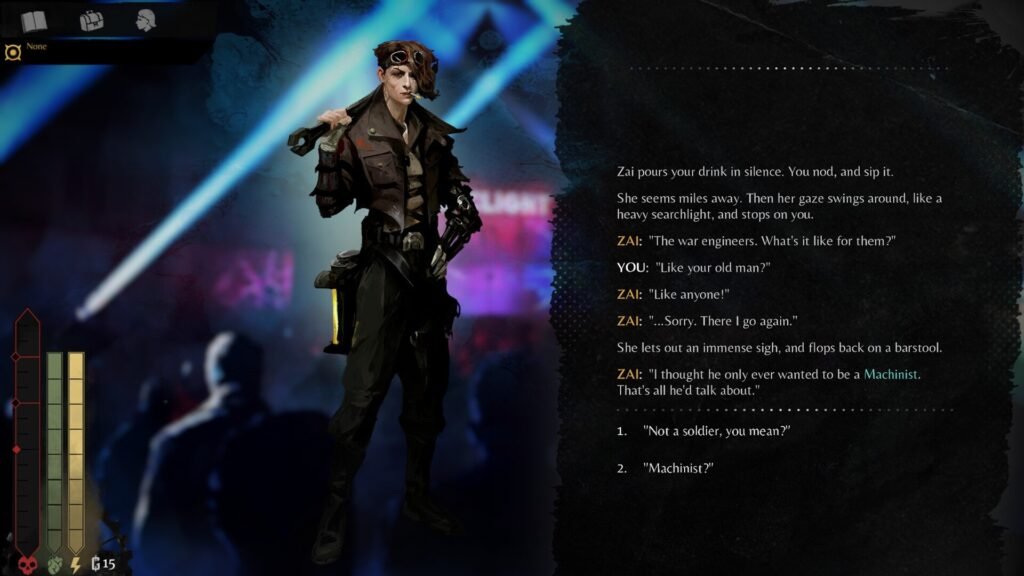
Where Duskpunk is a little more restrictive is your initial character build. I chose the Criminal background which gave me advantages in Sneak and Intuit, and you can also choose to be a Veteran, Engineer, or Writer. Although the terminology is different, these archetypes and stats fit into your standard Dungeons & Dragons character builds. The character you choose also determines the direction of the narrative you’re about to experience, especially in the first few hours.
The dice mechanics in Duskpunk are cruel but fair. You’re not going to win rolls on a stat you have 0 points in, but you’re going to have decent-to-good odds on a stat with 3 points or higher. For instance, with the Criminal background, I had little to no points in Engineer or Skirmish. That made it difficult for me to work in the factory or participate in brawls without constantly praying for a high roll. But I was good at other things. I could pickpocket using my high Sneak skill, or gather information in the night with my high Intuit skill.
What’s nice is the game always gives you multiple solutions to a single problem. If you’re weak in one stat, there are usually one or two more options for you to choose from. As you progress through the game, you can also level up weaker stats, allowing you to gain access to more story content albeit at a later point in the game. But even if you choose to take a risky dice roll, the game is balanced to take that into account.
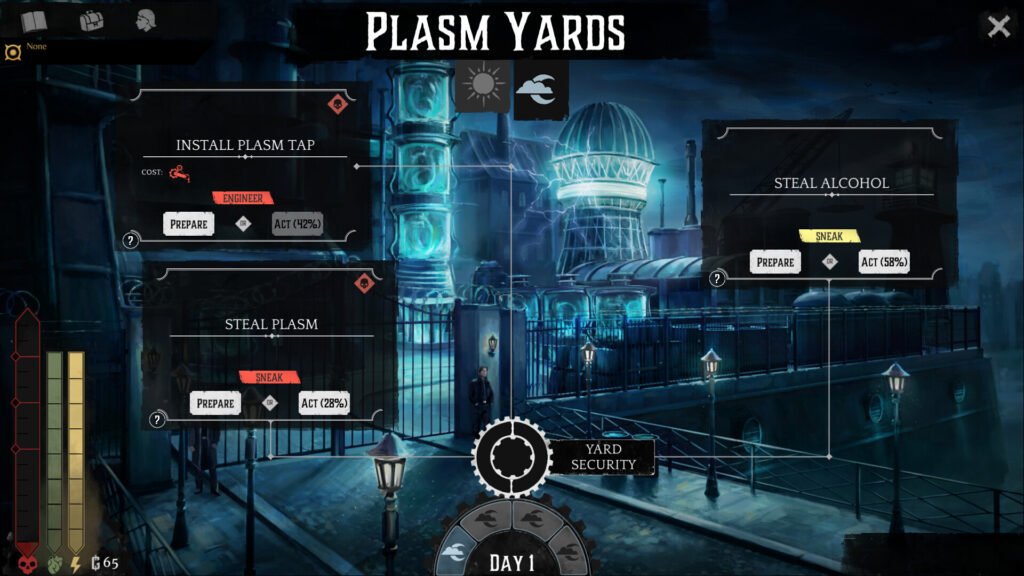
Duskpunk balances its gameplay through a complex web of failsafes. If your energy hits zero, then your health gets damaged. If your health hits zero, then your skill points get damaged. If your stress maxes out, you lose three dice faces on your six-sided die. And all of the above are temporary debuffs that can be restored through different methods. I wouldn’t even know how to reach a proper endgame state, except by intentionally crashing through multiple layers of protection.
The game evidently places very few restrictions on its player, and the least of all is time. There are time-sensitive main quests, but not so much so that you’re screwing up the quest the moment you take one false turn; as is the case with action economies in most games. Duskpunk is generous enough with its pacing that the narrative feels urgent without it constantly breathing down your neck, especially considering the game runs on a day-night action economy, and often features multiple overlapping main quests.
With so many quests happening at the same time, the game uses an interesting method to keep you on track. Rather than a traditional EXP system, you gain one Growth Point whenever you complete a main quest, which you can then use to level up any character stat. It’s a smart way of keeping you checked in with the main story and identifying which are the important quests, especially when there’s so much more to explore on the wider map.
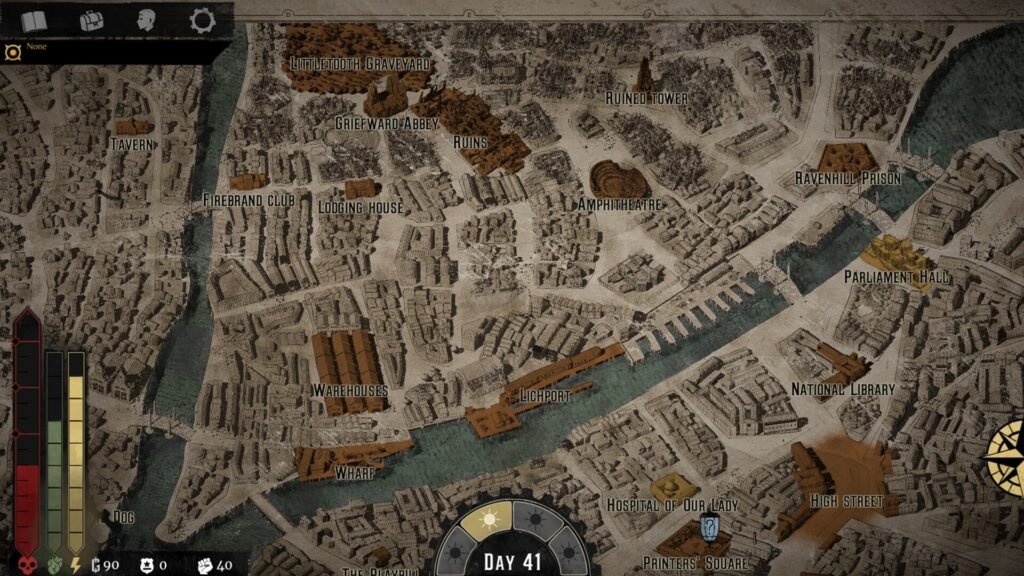
So rather than doing math all the time, and making sure I had enough actions to complete any given quest, I was really able to immerse myself in the experience. From infiltrating a gang in the slums, to taking on dangerous jobs from an information broker, to working part-time at an abbey, I got to experience the effects of the war on citizens from every social class, religious and political alignment.
Despite the heavy subject matter, the writing is relatively light and won’t leave you feeling fatigued from reading by the end of it. Nowhere near as heavy as Disco Elysium in terms of political prose, but straightforward enough for someone’s first romp into the subject matter, and layered enough to provide a thoughtful narrative experience for most players.
Overall, excellent execution is what makes Duskpunk shine. Even if its narrative doesn’t break any new grounds, but good pacing and balanced gameplay helps this eight-hour narrative game travel the extra mile. In fact, it shocks me how much optional content I missed out in my first run. Looks like it might be time to return to Dredgeport for round two.
Verdict: War Is A Cruel Mistress
This Citizen Sleeper-like roleplaying game quickly finds its own identity in the grimy streets of Dredgeport, where a narrative about politics and inequality comes to light with every dice roll you take. Featuring a perfectly paced narrative and dice mechanics that are punishing but fair, Duskpunk is a well-rounded addition to the world of dice-driven RPGs.