






It’s no secret that Southeast Asia’s horse racing scene has seen a sharp decline in viewership over the last few years. The 181-year-old Singapore Turf Club, which was one of Asia’s oldest horse racing clubs, closed in October 2024 due to financial losses and land scarcity in the island nation. Malaysia’s 161-year-old Penang Turf Club saw a similar fate, citing a lack of revenue for its closure earlier this May.
Malaysia’s second-oldest turf club, the Selangor Turf Club, was (and in many ways still is) fighting an uphill battle to stay afloat, not least because horse racing in Southeast Asia mainly conjures up images of elderly men drinking and gambling on their favourite horses. As Rosalind Lim of the Malayan Racing Association shared with CNA, “It’s still very much the old generation of fans and we have failed to attract the young audiences.”
Lim’s words may have proven prophetic, as an unlikely glimmer of hope would appear just a month after she gave that interview. Enter Umamusume: Pretty Derby.

For the uninitiated, Umamusume is a Japanese media franchise that spans multiple games and anime series, featuring anthropomorphised versions of primarily Japanese racehorses. The horses are reimagined as cute anime girls (complete with horse ears and tail) studying in a racing academy, and given personalities that reflect the horses’ real-life backgrounds and achievements. The franchise saw a boom in popularity with the global release of Umamusume: Pretty Derby, a mobile game where players can train and bond with these “horse girls”.
That bond between player and horse quickly transcended the game and into real life, with thousands of players worldwide famously banding together to send food supplies to Haru Urara, the real-life horse behind one of the game’s most beloved characters. On social media, threads explaining the horses’ personal backgrounds frequently go viral, speaking to the players’ desire to learn more beyond what’s presented to them in-game.


It’s a phenomenon that’s not entirely unique to Umamusume – games in Japan and China have long tapped into the same power of anthropomorphisation. Azur Lane, a game about historical warships, frequently collaborates with naval museums to raise awareness for warship preservation; while fans of Touken Ranbu, which centers around historical katana, once raised over USD$300k to restore a sword that inspired one of the game’s characters.
However, Umamusume is relatively unique in that its fans have not only embraced Japanese racehorses, but also the horse racing scene in their own countries. One of the first major races in Southeast Asia to see this effect was the IHR Indonesia Derby 2025, which took place on 27 July. The race’s livestream broadcast hit an unprecedented 15,000 concurrent viewers, many of whom flooded the live chat with Umamusume-related memes like “umazing!” (which quickly gave birth to the localised “umantap!” and “kudahsyat!”).
Over in Thailand, the Royal Turf Club of Thailand went viral worldwide when it allowed Umamusume cosplayers to conduct a race of their own on the track. Malaysia’s own Selangor Turf Club would join the trend on August 31, welcoming over a hundred Umamusume fans who had come to watch the club’s Merdeka Race celebrations. For a time, regional fan groups for the game lit up with discussions of not just in-game characters, but also racehorses from their own backyards.
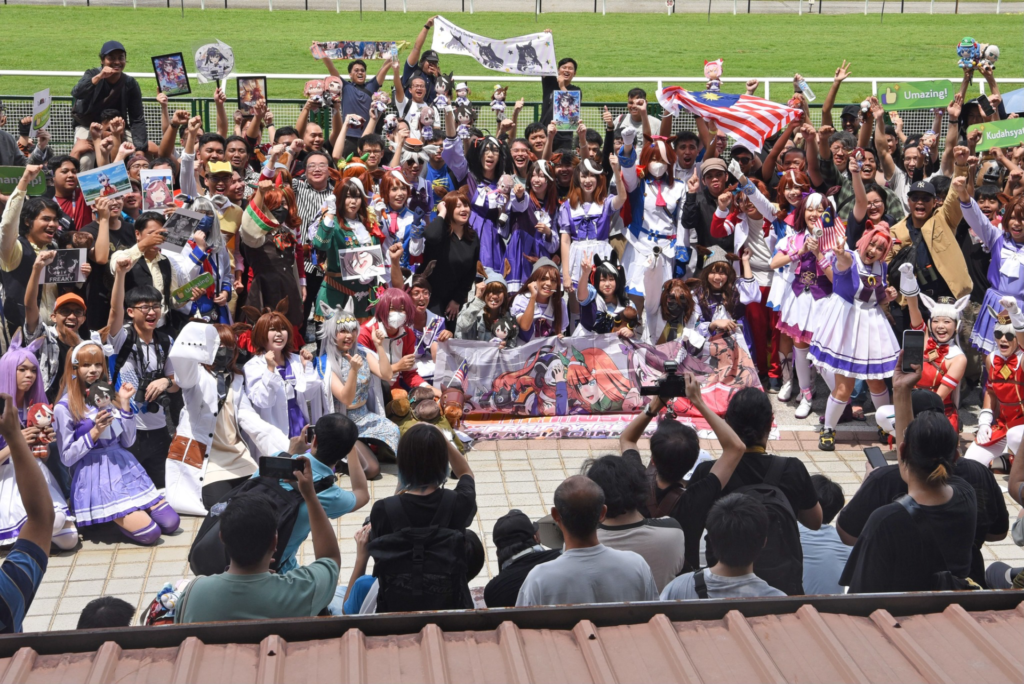
Umamusume’s influence is undeniable, but it’s a little more difficult to explain how exactly the game inspired its fans to embrace local horse races. If I had to guess, it seems to be the perfect combination of multiple domino pieces falling into place. Umamusume players who had learned about horse racing through the game would become encouraged to check out their local turf clubs, who in turn were already thinking of reaching out to younger audiences, and thus quickly seized the opportunity to cater to new fans.
It’s also worth mentioning that Cygames, the developer behind the Umamusume franchise, is itself heavily entrenched in real-world horse racing, having sponsored major international races such as the Grand Prix de Paris and the Kentucky Derby. While the company has yet to sponsor a Southeast Asian race, it definitely seems within the realm of possibility.
For now, the question still remains if turf clubs across the region will be able to capture lightning in a bottle. Some institutions, like the Perak Turf Club, were already trying to attract younger visitors by adding facilities like retail outlets, swimming pools and even a pickleball court to their club grounds; others like Indonesia’s Sarga have launched fanart contests encouraging new viewers to turn Indonesian racehorses into Umamusume.
However, only time will tell if these new fans can be converted into long-time patrons of horse racing. Until then, with more gameplay updates and community events on the horizon, the Umamusume trend seems like it’s still got some major horsepower in the tank.